
What truly determines whether something fits or not is not the front.
When first wearing a black corset, most people’s attention is drawn to how it looks in the mirror.
Is the waistline more defined?
Have the body proportions changed?
Does the garment fit better?
But soon you might realize a problem:
when you turn around and look at your back—
is the gap in the middle of that frenulum normal?
Some people think that’s “unprofessional,” some worry that they bought the wrong size, and others simply pull it closed completely.
Table of Contents
1. What is the corset frenulum gap? Why is it almost always present?
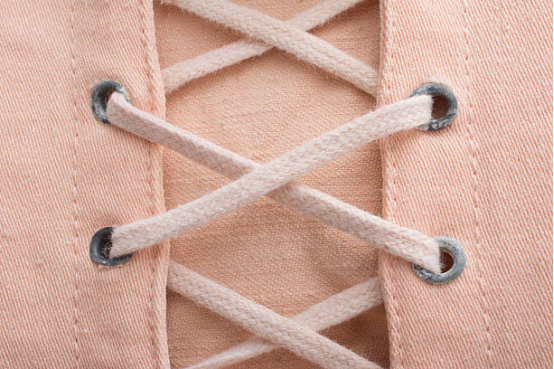
In professional corset construction, the lacing gap refers to the longitudinal gap that naturally forms between the two back panels on the left and right sides after the corset is worn.
This gap wasn’t created randomly, nor was it “not tightened enough.”
It’s a functional structure reserved during the design phase.
From a functional perspective, the lacing gap of the corset mainly serves three purposes:
- Adjusting tension: This allows for more even distribution of stress on the lower back, back, and ribs.
- Adapting to change: responding to minor fluctuations in weight, body shape, and breathing patterns
- Protective structure: Prevents the steel frame from being subjected to extreme pressure for extended periods.
In other words,
black corsets without frenulum gaps are often in an unhealthy state.
2. What is the ideal width for the black corset lacing gap?
This is the most searched question, but it’s also the one most easily misunderstood.
1. Mainstream professional recommendation: 2–5 cm
Based on the experiences of many corset makers, brand guides, and wearers,
the ideal lacing gap for a corset is typically between 2 and 5 centimeters.
This range was not given arbitrarily but is the result of a balance achieved through long-term practice:
- Less than 2 cm: Insufficient adjustment space, excessive long-term pressure
- Larger than 5 cm: Shaping efficiency decreases, and stress may not be concentrated.
Unless you have specific needs, this range is suitable for almost 90% of black corset-wearing scenarios.
2. Why is “complete closure” not a good thing?
This is one of the most common pitfalls for beginners.
Many people subconsciously believe that
only when a black corset is stretched to have no gaps can it indicate that the size is correct and the shape is strong.
However, from a professional perspective, complete closure usually means:
- Corset sizes run large.
- The space for waist shaping was used up in advance.
- It is almost impossible to adjust it later.
It may look “tight” for a short time,
but wearing it for a long time can actually make it more uncomfortable and deformed and even shorten the lifespan of the corset.
3. The lacing gap of a corset varies depending on the wearing scenario.
This point is often glossed over in a single sentence, but in reality, it is extremely important.
1. Everyday wear style black corset
If you’re using a black corset for everyday wear, commuting, or long-term wear:
- Recommended fretting gap: 3–5 cm
- Core objectives: stability, comfort, and sustainability
You should be able to breathe naturally, sit for long periods, and walk, rather than constantly feeling “reminded.”
2. Black corset for formal wear/photoshoot/short-term styling.
When more defined lines are needed:
- Recommended fretting gap: 2–3 cm
- It’s permissible to be tighter, but it shouldn’t be painful.
The visual effects can be stronger, but only if
they don’t compromise safety and breathing.
3. Advanced shaping for experienced wearers
For those who are already very familiar with corsets:
- The fretting gap may be smaller.
- However, this must be based on correct sizing and experience.
This type of method is not recommended for beginners to imitate.

Fourth, even more important than “width” is actually the shape of the tether gap.
This is a point of judgment that is often overlooked but is very important in the professional field.
A proper black corset tether clearance should have these characteristics:
- Basically parallel up and down
- The steel frame remains vertical
- Even tension distribution
Common but dangerous error patterns include:
- Narrow at the top and wide at the bottom: Excessive pressure on the waist
- Wide at the top and narrow at the bottom: Abnormal stress on the ribs or thoracic cavity
- Wavy gap: The size or tying method is obviously incorrect.
Even if the gaps in your black corset “don’t look big,”
it can’t be considered a true fit if the shape isn’t right.
5. What does an abnormal corset tether gap usually indicate?
1. Excessive lacing gap
Possible reasons include:
- Black Corset runs small.
- Body proportions do not match the pattern
- The belt was not adjusted starting from the middle of the waist.
In this case, the shaping effect will be significantly weakened, and the wearing experience will be unstable.
2. The fretting band gap is too small or absent.
This usually means:
- Black Corset runs large
- Early “makeshift purchases”
- Later, the body condition changed.
The adjustment space for this type of black corset is very limited.
6. How to properly adjust the straps of a black corset? (Hands-on demonstration)
This is the real source of many problems.
by fixing the most supportive position from the middle of the waist and then extending upwards and downwards.
Step 2: Adjust both sides simultaneously.
Pulling too much on either side will cause structural imbalance.
Step 3: Stand up
straight after putting it on and observe from behind whether the gaps between the straps are parallel.
Many discomforts are not due to the corset itself, but rather to the way it is adjusted.
7. Will the lacing gap of a black corset change over time?
The answer is definitely.
- The new Black Corset needs a break-in period.
- Physical condition changes with the seasons and daily routines.
- The fabric and ties will gradually adapt.
Therefore, the ideal lacing gap is not set all at once but is a process of continuous fine-tuning.

8. Common Misconceptions about Black Corset Latency
- ❌ Smaller gaps mean greater professionalism
- ❌ Complete closure makes you look slimmer
- ❌ All corsets should adhere to the same standard.
A truly well-fitting corset is a balance of structure, safety, and body feedback.
FAQ: Frequently Asked Questions about Black Corset Latency
Q1: Must the tie gaps on a corset be perfectly parallel?
Yes. Significant non-parallelism usually indicates uneven stress or dimensional incompatibility.
Q2: Is it normal for the gaps in a newly purchased corset to be a bit large?
Yes, it is normal. New corsets need an adjustment period; it’s not recommended to tighten them all at once.
Q3: Will the strap gap of a corset differ depending on body type?
The width range is similar, but the comfort point varies from person to person. You should refer to your body’s feedback.
Q4: Will the gap in the straps affect the lifespan of the corset?
Yes. Prolonged excessive tightness or uneven stress will accelerate fatigue of the steel frame and fabric.
Conclusion:
To truly understand a corset is to truly understand a lacing gap.
A truly well-fitting black corset
doesn’t prove its value by being “tightened up.”
When you begin to observe, understand, and respect the gaps in the straps,
a corset is no longer just a shaping tool.
but a structural garment that works in harmony with your body.