
When discussing corset care, “Can black corsets be soaked in water?” is one of the most frequently searched questions.
At first glance, this may seem like a simple cleaning detail, but anyone who has actually worn a black corset knows that an incorrect immersion in water can significantly shorten its lifespan.
Some people found that the color was no longer pure after soaking;
some people realized that the waistline no longer fit properly after drying.
and some people did not find that fine rust spots had appeared on the internal steel frame until weeks later.
Therefore, this article will not simply tell you “can be washed” or “cannot be washed,” but will systematically explain, in conjunction with the structure, material, and actual wearing scenarios, what you really need to pay attention to when immersing a black corset in water.
Table of Contents
Why can’t the black corset be cleaned arbitrarily?
If you treat a corset like regular underwear, that’s where the problems often begin.
Unlike everyday clothing, black corsets are highly structured garments that rely on internal support systems rather than the elasticity of the fabric. These structures include:
Multi-layer composite fabric (outer layer + inner lining + waistband layer)
- Plastic or steel skeleton
- Metal front buckle
- Metal eyelets on the back
- Dark dyes (especially black)
These factors combined make a corset extremely sensitive to moisture.
Water itself isn’t the problem; the problem is “prolonged, uncontrolled exposure to water.”

Can corsets be submerged in water? Let’s look at these three practical conditions first.
Before actually putting the corset into the water, it is recommended that you pause for 30 seconds and confirm the following three points.
1. Is the fabric itself suitable for contact with water?
Not all black corset fabrics are the same:
- Cotton/polyester blend: relatively stable, but soaking time still needs to be controlled.
- Velvet, silk, and lace combination: extremely sensitive to moisture.
- Glue-bonded fabrics: prone to delamination or wrinkling after being soaked in water.
If your black corset is primarily for decoration rather than everyday wear, the risk of it getting wet is often underestimated.
2. Does it contain a steel frame or metal structure?
Most highly malleable black corsets contain a steel frame.
It’s important to note that a steel frame does not guarantee complete rust prevention, especially in the following situations:
- Moisture is trapped inside the fabric layers
- Incomplete drying
- The environment is humid when storing.
These problems usually don’t appear immediately but rather slowly affect the overall lifespan of the corset.
3. The true signals given by the shampoo and conditioner labels
If the label contains the following words:
- Hand wash only
- Do Not Soak
- Dry Clean Recommended
This is actually a clear indication from the brand:
The black corset is not suitable for soaking.
Common risks of immersing corsets in water (which many people underestimate)
Fading is the most easily overlooked problem.
Black dyes are not always stable in water, especially in:
- Water temperature is too high
- Use regular laundry detergent
- Soak for more than 10–15 minutes
Once a black corset shows even slight fading, it is very difficult to restore its original deep black texture.
Hidden damage to metal parts
Even if no problems are visible on the surface, moisture may have already seeped between the steel frame and the fabric.
This unseen damp environment is where corrosion truly occurs.
Structural relaxation and decreased plasticity
Soaking in water allows the fibers to fully absorb water, and under the influence of gravity:
- The waistline was elongated
- Displacement of the stress point
- The overall shaping effect is weakened.
These kinds of problems are often irreversible.
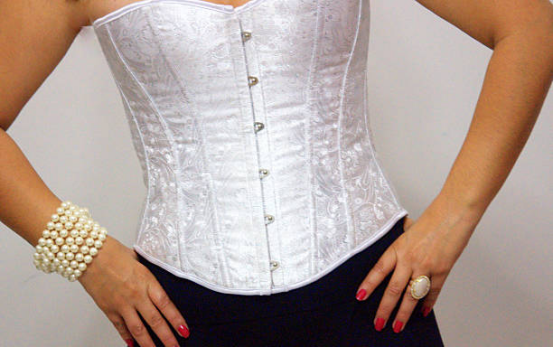
If immersion in water is necessary, the correct procedure for Black Corset is as follows.
In some situations (such as after heavy sweating), short-term immersion in water is acceptable, provided that the process is strictly controlled.
Step 1: Use cold water, not warm water.
It is recommended to keep the water temperature below 30°C.
Cold water can effectively reduce the risk of dye migration and is also more conducive to maintaining structural stability.
Step 2: Choose a truly gentle cleaner
Recommended use:
- Special detergent for underwear or silk
- The lower the dosage, the better.
Avoid using:
- bleach
- High-efficiency stain remover laundry detergent
- Enzyme-containing cleaning products
Step 3: Soaking time should be controlled at 5–10 minutes.
Black corsets are not cleaned by soaking.
After a short soak, gently press the area that needs cleaning with your hand.
Step 4: Never twist.
Wringing is one of the most dangerous actions in corset care.
Simply press lightly to drain and maintain the overall shape.
The drying method for a black corset is often more important than washing.
Many corsets are damaged not during the washing stage but during the drying stage.
Recommended drying method
- Use a dry towel to absorb excess moisture.
- Lay flat to dry, maintaining the original waistline.
- Place in a well-ventilated, cool place
Practices to be avoided
- Hanging to dry (will stretch the structure).
- Direct sunlight (accelerates fading)
- Using a dryer (directly damages the internal structure)
Black corsets are only suitable for storage after they are completely dry.
A safer cleaning alternative to immersion in water: Black Corset
In fact, in most cases, corsets do not need to be soaked in water for cleaning.
Local cleaning
- Damp cloth + neutral detergent
- Gently pat the stained area
- Avoid repeated friction
Ventilation and odor removal
Wearing the garment and letting it ventilate for 24 hours
is often more effective than washing it.
Professional dry cleaning (choose carefully).
Make sure the dry cleaner is familiar with corsets or structured garments.

Long-term care advice: Reducing the frequency of immersion is key.
To keep your black corset in good condition long-term, we recommend:
- Avoid wearing it for several consecutive days.
- Wearing an inner layer reduces direct contact with sweat.
- Do not clean unless necessary
- Keep dry and flat when storing.
Restrained washing is itself a form of professional care.
FAQ: Frequently Asked Questions about Black Corset Submersion
Q1: Can I not wash my corset at all?
A: If you only wear it lightly, ventilation and spot cleaning are usually enough.
Q2: Can I use a washing machine with a corset?
A: It’s not recommended. Even on a gentle cycle, it can easily damage the structure.
Q3: How often should a corset be washed?
A: There is no fixed frequency. It depends on the actual amount of wear. Wash it as infrequently as possible.
Conclusion: Consider the cost before you start cleaning.
Immersing a black corset in water isn’t necessarily a bad choice, but it’s never the default option.
Every immersion is a test of its color, structure, and lifespan.
If you want your corset to maintain its shape and texture for a long time, remember this:
avoid soaking if possible; if you must soak, be very careful.
This is a more professional approach to nursing care.