
The allure of a black corset often comes not only from its cut or steel frame.
What truly determines the wearing experience is often an easily overlooked detail—the ties and ribbons.
Many people have similar questions when wearing a corset for the first time:
Why do corsets that look the same look so different on different people?
The answer is often hidden in those few inconspicuous straps at the back.
This guide to black corset ties and ribbons won’t just offer “standard answers.”
We’ll use real-life wearing scenarios to explain from a practical perspective:
how to choose, how to tie, when to change, and which areas truly shouldn’t be compromised.
Table of Contents
Why are the laces on a black corset more important than you think?
If the fabric determines the first impression, then the ties determine the long-term experience.
The back strap of a black corset actually serves three functions:
- Adjust the overall tightness to fit different body types.
- Distribute the force to avoid localized compression
- Fixed structure to keep the steel frame in the correct position
Many cases of failed shaping are not due to a bad corset itself, but rather to an incorrect way of tying it.
In other words,
the same black corset, with different lacing methods, is almost like two different garments.
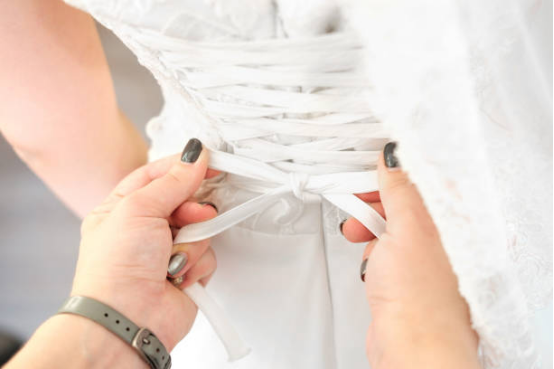
A detailed explanation of common black corset lacing types (not just based on appearance)
Black corset laces on the market can be roughly divided into three types.
They look similar, but the actual experience varies significantly.
Flat webbing: the safest choice
This is the brand’s most commonly used configuration, and it’s also the least likely to go wrong.
advantage:
- Large stress area
- It won’t cut your hand when tightened.
- It is not easy to slip on the metal hole.
If this is your first time wearing a black corset,
or if you plan to wear it for an extended period of time, flat webbing is almost always a “safe option.”
Circular rope: Looks good, but requires some compromise.
This type of tie is commonly found on vintage or display corsets.
The characteristics are very clear:
- Visually exquisite
- But the friction is low.
- It tends to spring back when stretched.
Suitable for light shaping.
If you’re looking for everyday comfort rather than extreme waist reduction, it’s acceptable.
Ribbon ties: more decorative than functional
Many people are attracted to the texture of ribbons.
That’s understandable.
However, it must be noted that
ribbons are not designed for load-bearing.
It is more suitable for:
- Photograph
- Design Showcase
- Lightly decorative
When used for actual shaping, it is generally recommended to use it in conjunction with webbing.
How to choose the right ribbon for a black corset?
Not all ribbons are suitable for corsets.
If you choose the wrong one, problems will quickly become apparent.
Material selection is more important than color.
- Polyester ribbon: stable and not easily stretched.
- Satin ribbon: beautiful, but slippery.
- Cotton ribbon: strong friction but relatively short lifespan.
If your corset requires repeated adjustments to its tightness ,
prioritize stability over mere decorative effect.
The width of the ribbon directly affects the user experience.
Based on experience:
1.5–2.5 cm is the range of relative equilibrium.
Too narrow: It can easily get stuck in the eyelet.
Too wide: Significantly reduces the efficiency of putting on and taking off clothes.
This is a small detail that many beginners easily overlook.
The standard lacing method for black corsets: Why is the X-type recommended?
Of all the lacing methods, the X-type lacing method is the most widely used and has the highest tolerance for error.
The logic behind the X-shaped lacing system is actually quite simple.
- Crossing from top to bottom
- A “handle loop” is provided at the waist.
- Finally, tighten all at once.
The advantage of doing this is that
the pressure is concentrated in the lower back, but it does not affect the upper chest or lower back.
3 common mistakes beginners make
Almost everyone who wears a corset for the first time will encounter these pitfalls:
- Tighten to the maximum in one go
- Ignore mid-range adjustment
- Uneven force distribution on the left and right sides
The correct approach is to
proceed slowly and adjust in stages.
Black corsets are never shaped by “pulling” them too hard.
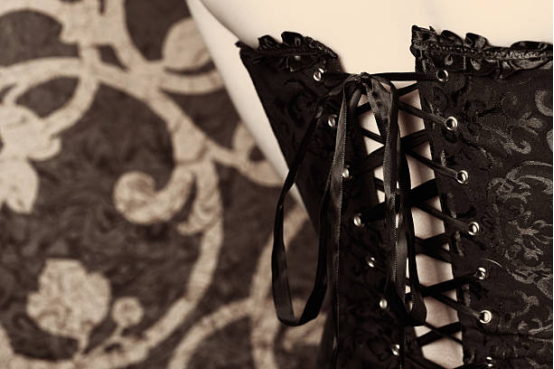
Safety and comfort recommendations for black corset straps
Here I must say something realistic:
not all discomfort is part of the “shaping process.”
In everyday wear, it is recommended to follow these principles:
- For first-time wear, leave 3–5 cm of space at the back.
- Do not wear continuously for more than 2–3 hours at a time.
- If you experience tingling or numbness, relax immediately.
A good black corset
should make you feel supported, not oppressed.
Daily Care Guide for Ties and Ribbons
Many people take great care of the corset itself.
but neglect the straps.
Cleaning recommendations
- Try to avoid immersing the entire laces in water.
- Removable ribbon for separate washing
- Use a neutral detergent.
Storage suggestions
- Loosen the straps completely before storing.
- Avoid tying a knot
- Keep dry and well-ventilated
These details can really affect the lifespan of a corset.
Is it necessary to replace the original black corset laces?
The answer is: It depends.
In the following situations, it is recommended to consider replacement:
- The ties are visibly frayed and deformed.
- The original strap length is not suitable for individual body types.
- Want to adjust the overall style
However, please note:
changing the strap is not simply “changing any rope”;
the strength and length must match.
FAQ: Frequently Asked Questions about Black Corset Ties and Ribbons
Q1: Can a corset be tied with only ribbon?
A: Not recommended. Ribbons are more suitable for decoration, but their load-bearing capacity is limited.
Q2: How long should the corset straps generally be?
A: After putting it on, it is recommended to leave 20-30 cm of extra length at the back.
Q3: Will the metal tie hole be damaged?
A: It won’t with normal use, but excessive tension or the use of an unsuitable ribbon will increase the risk.
Q4: Can I frequently change to different colored ribbons?
A: Yes, as long as the material and width meet the structural requirements of the corset.

Conclusion: The lacing system is the most easily underestimated core component of the Black Corset.
Of all the details in a corset,
the ties and ribbons are never the most eye-catching part.
But it is precisely these factors
that determine whether a corset fits “just right”
or “something just doesn’t feel right.”
Understanding corset ties and ribbons
is not about pursuing complicated techniques,
but about making everywhere more reassuring, comfortable, and durable.